New driveways in Hastings
Get your starting price by email. Then book a visit for a fixed price in writing.
Written price · Photos of the work · Written guarantee
Free price planner · Step 1 of 3
Zero Salesmen. Just Honest Starting Prices.
Instant estimate to your inbox. No salespeople, no phone calls.
1. What do you want?
2. What surface do you like?
3. About how big is your driveway?

- 10-year guarantee on base and surface
- Fully insured
- Fixed price in writing

The Vale Stronghold Company Ltd · Company no. 17431358
Not ready to call?
Send a photo and your postcode. We'll reply on WhatsApp.
A clear plan before we start
- We measure your drive.
- We check the ground and where the rain will go.
- We agree the work with you.
- We write down the work and the price.
- We take photos as we build.
Help after the work is done
You get your guarantee in writing before we start. It says what we cover, how long it lasts and what is left out.
Keep it with your written price and the photos of the work.
If something goes wrong, call us or send us a message. If our guarantee covers it, we put it right at our cost. If it does not, we tell you why in writing.
Want us to take care of it?
Ask Cosmin if our manager can visit today.
When we can check and agree the whole job at the visit, you get your written price that day. If more checks are needed, we tell you what comes next and when your price will be ready.
Ask for a visitA driveway carries the weight of your car, so what goes under it matters. We dig out, lay a membrane, put down 150mm of packed stone and set the edges in concrete. Then you choose the top.
The surfaces, compared
Block paving
Price by email
The most repairable surface there is: lift a block, fix what's underneath, put it back. Widest choice of colour and pattern, and the only one that lets you do a soldier course or a curved edge detail.
Tarmac
Price by email
The cheapest way to cover a large area properly. Fast to lay, hard-wearing, plain to look at, and it needs the base doing just as thoroughly as anything else.
Imprinted concrete
Price by email
One poured, coloured and patterned slab. Seamless, no joints for weeds, and good value over a big area — but it's impermeable and it can only be repaired as a slab.
Gravel
Price by email
Cheapest per square metre, fully permeable, and much better than its reputation when laid over a proper sub-base with a gravel grid to stop it migrating.
Every figure is a starting price. What moves it: access for a machine and a grab lorry, how much comes out and where it goes, whether the drainage needs work, and how much cutting the shape demands.
Permeable driveways and where the water goes →
Repairing a driveway rather than replacing it →
How each surface fails
Every quote you get will tell you what a surface does well. This is the other half — cost, lifespan, upkeep, permeability and, most usefully, the specific way each one goes wrong. Pick the surfaces you're weighing up and read them side by side. All figures are guide starting prices for this region.
Comparing 3 of 4 surfaces
Block paving
- Guide cost
- Price by email
- Realistic lifespan
- 20+ years on a correct base
- Maintenance
- Re-sand joints occasionally, sweep, lift and relay any settlement
- Permeable?
- Only in a permeable build-up
- How it fails
- Sinks and rocks where the sub-base was shallow or unhaunched, and weeds germinate in open joints. The upside: single blocks lift and go back with no patch line.
Tarmac
- Guide cost
- Price by email
- Realistic lifespan
- 20+ years on a correct base
- Maintenance
- Keep fuel and standing water off it; no sealing needed
- Permeable?
- No, unless a porous grade
- How it fails
- Scuffs where wheels turn on the spot and softens in a heatwave, so point loads — jockey wheels, trailer legs, bike stands — indent it. Ruts if the base was thin.
Imprinted concrete
- Guide cost
- Price by email
- Realistic lifespan
- 15–25 years, resealed
- Maintenance
- Reseal every 3–5 years or the colour dulls
- Permeable?
- No
- How it fails
- It is one slab, so it cracks as one piece — you can't lift and replace a unit. It gets patched or resurfaced, and the colour fades if the sealer is left too long.
Note what all four failure modes have in common: three of them start in the base, not the surface. That is why we talk about excavation depth before we talk about colour.
When a new driveway is worth it — and when it isn't
When it's the right choice
- The surface is rutting, rocking or holding water. That's the base failing, and no amount of pressure washing fixes it.
- You need more parking, a wider entrance, or a turning area, and the layout has to change anyway.
- Water currently runs off the drive towards the house or onto the pavement. Rebuilding lets us deal with it.
- You're doing other work — an extension, new front garden, a dropped kerb — and the drive will be dug up regardless.
When it isn't — say so and pick something else
- The surface is only tired-looking. Cleaning, re-sanding and replacing a few blocks costs a fraction of a rebuild and often buys years.
- One area has sunk over a service trench. That's a localised repair; relaying the whole drive to fix two square metres is money badly spent.
- You want a surface that can't do the job you need. Imprinted concrete over a base that moves will crack; gravel on a steep slope will migrate onto the road.
- The budget won't cover the excavation depth. A shallow base under a good-looking surface is the most expensive mistake on this whole site — we'd rather not take the job.
The build-up under every driveway we lay
Excavate to depth and cart away — typically 250–300mm for a domestic drive, deeper on soft ground. Separation membrane over the formation so the sub-base can't work its way into the subsoil. MOT Type 1 laid and compacted in layers to 150mm consolidated.
Edge restraints haunched in concrete on both sides, because a driveway without a restrained edge spreads outwards and the joints open. Falls set away from the house and the water taken to a soakaway, a channel drain or a permeable margin — never onto the highway.
Laying a driveway around an EV charge point
If there's already a charge point on the wall, the paving has to be cut in around it and the falls have to keep water away from the base of the unit — not pond against it. Where a channel drain runs along the house, we take it past the charger rather than stopping short and leaving a wet corner.
If a charger is coming later, say so before we excavate. We lay ducting under the sub-base while the ground is open and before it's compacted, and bring draw cord out at both ends. It costs very little at that stage and it's the difference between a cable running underground and a cable surface-clipped along your brickwork forever.
To be clear about what we are and aren't doing: we don't install the electrics. A qualified electrician makes the connection. We lay the drive properly around the unit and we put the duct in while it's cheap to do.


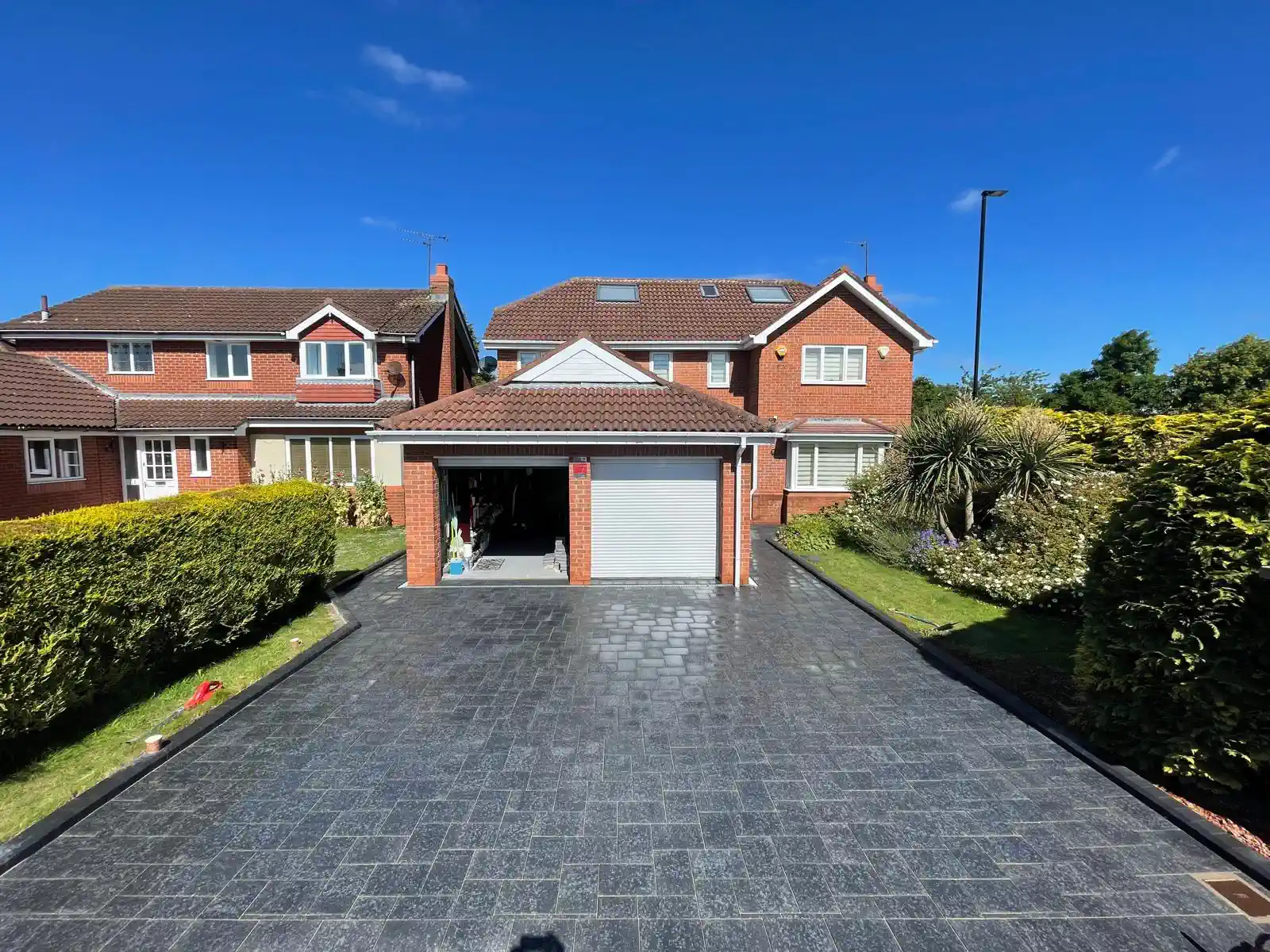
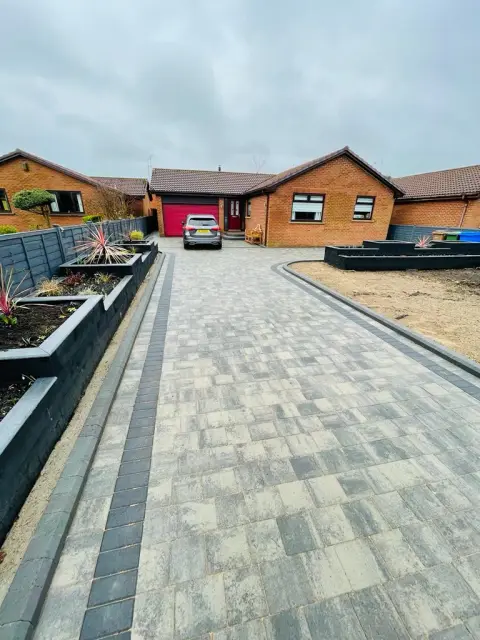
Driveways we've built
Every photograph on this site is our own completed work. We don't name streets.




A fixed price before anyone starts digging
We measure, agree the build-up in writing and give you one price. It doesn't move. Not for hard ground, old concrete, rubble, roots or a soft spot — that's our risk and it's already in the number.
Zero deposit option for jobs that qualify — we confirm the terms with your fixed price.
Everyone else quotes "subject to survey" because they haven't checked the job properly. We do the survey first — measuring properly, checking levels and where the water goes, what planning rules apply, what has to come out, manholes, ducts, and access for digger and skip. So by the time we write the number down, we know what the job needs. That's why the price doesn't move, and why we can put it in writing before we start. If we ever do hit something, we stop, show you, and agree in writing what happens before we carry on. Ask your other quotes what they checked before they priced.
Ten years on the sub-base, ten years on the surface
Most guarantees quietly stop at the surface. Ours starts underneath it: the excavation depth, the membrane, the compacted sub-base, the falls and the edge restraints carry ten years, because that is the part that sinks and the part you can't check. The paving on top carries ten as well, because the laying is our workmanship — wear, staining and fair fading are the only things it doesn't cover, and the full terms say exactly which.
Common questions about driveways
Which driveway surface lasts longest?
They all last a long time if the base is right and fail early if it isn't, which is why we talk about depth before we talk about surface. Block paving has the practical edge because it can be lifted and relaid; tarmac and imprinted concrete have to be patched, and a patch always shows.
Do I need planning permission for a new driveway?
Not for a permeable surface of any size, and not where the water runs off onto a lawn or a border. You do need permission for more than five square metres of impermeable surfacing draining onto the road. This applies to houses, not flats.
Can you lay a new driveway over the old one?
Sometimes, and we'll tell you honestly whether yours is a candidate. A fresh tarmac wearing course over a sound existing base can be a legitimate, cost-effective build. Laying over a cracked, moving or unknown base is how you buy the same problem twice.
How long does a driveway take?
A typical two-car block paved drive of around 50m² takes four to five working days: a day to excavate and cart away, a day for membrane and sub-base, then laying, cutting and jointing. Drainage work, a dropped kerb or difficult access can add a day or two.
Can I park on it straight away?
Block paving, yes, as soon as it's jointed and the edges have cured. Tarmac needs a few days before you turn tight on it, especially in hot weather. Imprinted concrete needs longer again while it cures and is sealed — we'll give you the exact times on the day.
Why is every price a starting figure?
Because access, what has to come out, ground conditions, drainage and edge detail all affect the final cost. The calculator gives you a starting figure; once we've measured, your price is fixed.
Before anybody digs: three things to check
Planning permission, the kerb crossing and where the water goes. We work these out with you at quote stage — these pages explain the rules so you can check them yourself.
- Do you need planning permission? The 5m² rule →Which surface you pick decides whether you need it at all — anything that drains to a soakaway or a permeable build-up stays under permitted development.
- Dropped kerbs in East Sussex — who approves it and the order it goes in →
- Where the water is supposed to go →
East Sussex Highways: dropped kerb (vehicle crossing) applications (opens in a new tab)The highway authority's own page, with its current fees, criteria and approved-contractor process.
Download the “Before anybody digs” checklist (PDF)Two pages you can print and take round the drive — planning, kerb, drainage, and the questions to ask before accepting anyone's quote.
Working out the money
Towns we cover
We cover Hastings and a 25-mile radius.
- Hastings
- St Leonards-on-Sea
- Bexhill-on-Sea
- Battle
- Rye
- Eastbourne
- Hailsham
- Robertsbridge
Worth reading
- Why driveways sink, and whose fault it is
Four causes, and how to tell which one you've got from the shape of the failure — plus when a lift and relay fixes it and when the whole drive has to come up.
Includes: how to lift one block and check your own sub-base depth