New block paving driveways in Hastings
Get your starting price by email. Then book a visit for a fixed price in writing.
Written price · Photos of the work · Written guarantee
Free price planner · Step 1 of 3
Zero Salesmen. Just Honest Starting Prices.
Instant estimate to your inbox. No salespeople, no phone calls.
1. What do you want?
2. What surface do you like?
3. About how big is your driveway?

- 10-year guarantee on base and surface
- Fully insured
- Fixed price in writing

The Vale Stronghold Company Ltd · Company no. 17431358
Not ready to call?
Send a photo and your postcode. We'll reply on WhatsApp.
A clear plan before we start
- We measure your drive.
- We check the ground and where the rain will go.
- We agree the work with you.
- We write down the work and the price.
- We take photos as we build.
Help after the work is done
You get your guarantee in writing before we start. It says what we cover, how long it lasts and what is left out.
Keep it with your written price and the photos of the work.
If something goes wrong, call us or send us a message. If our guarantee covers it, we put it right at our cost. If it does not, we tell you why in writing.
Want us to take care of it?
Ask Cosmin if our manager can visit today.
When we can check and agree the whole job at the visit, you get your written price that day. If more checks are needed, we tell you what comes next and when your price will be ready.
Ask for a visitBlock paving is laid on sharp sand over a deep stone base, with firm edges all round. If one block is ever damaged, we can lift it and put it back. You also get the most choice of colour, pattern and border.
Block paving driveway
Price by email
Permeable blocks and clay pavers sit at the upper end. Excavation, cart-away, membrane, 150mm sub-base and haunched edges are all included.
See how the price is built up → · Why we're not the cheapest quote you'll get
Before anybody digs: three things to check
Planning permission, the kerb crossing and where the water goes. We work these out with you at quote stage — these pages explain the rules so you can check them yourself.
- Do you need planning permission? The 5m² rule →Standard blocks bedded on sand shed water, so over 5m² you either specify permeable blocks or drain to your own ground.
- Dropped kerbs in East Sussex — who approves it and the order it goes in →
- Where the water is supposed to go →
East Sussex Highways: dropped kerb (vehicle crossing) applications (opens in a new tab)The highway authority's own page, with its current fees, criteria and approved-contractor process.
Download the “Before anybody digs” checklist (PDF)Two pages you can print and take round the drive — planning, kerb, drainage, and the questions to ask before accepting anyone's quote.
When block paving is right — and when it isn't
When it's the right choice
- You want to be able to lift and relay sections later — for a service trench, a new gate post, or a settled patch.
- The shape is complicated: curves, a bay window to follow, an awkward taper. Blocks cut to almost anything.
- You want a defined border, a contrasting soldier course, or a pattern that ties into brickwork on the house.
- You need permeable drainage without a soakaway — permeable block paving handles it in the build-up.
When it isn't — say so and pick something else
- You want a completely smooth, jointless surface for wheelchairs, prams or a scooter. Blocks have joints and a slight texture, and large-format porcelain or tarmac will do better on that count.
- The area is very large and plain. Tarmac will cover it properly for less money and blocks won't add much over that size.
- You won't sweep it, ever. Blocks stay looking good with occasional maintenance; neglected, moss in the joints will show sooner than on tarmac.
- There's a steep slope with heavy surface water running down it. It can be done, but the drainage design matters more than the surface and we'd want to look at it first.
How we lay a block drive
Excavate to 250–300mm, membrane down, MOT Type 1 compacted in layers to 150mm. Edge restraints set on and haunched with concrete before anything else is laid — that's the part that stops the field spreading.
Screeded sharp sand laying course, blocks laid off a string line, cuts done with a disc cutter against a marked line rather than eyeballed. Then kiln-dried sand brushed in and the whole surface vibrated with a plate compactor on a rubber mat, twice, with a second sanding in between.
Manhole covers get a recessed tray infilled with the same blocks wherever the cover allows it. The full build sequence is here →
Block paving we've built
Every photograph on this site is our own completed work. We don't name streets.
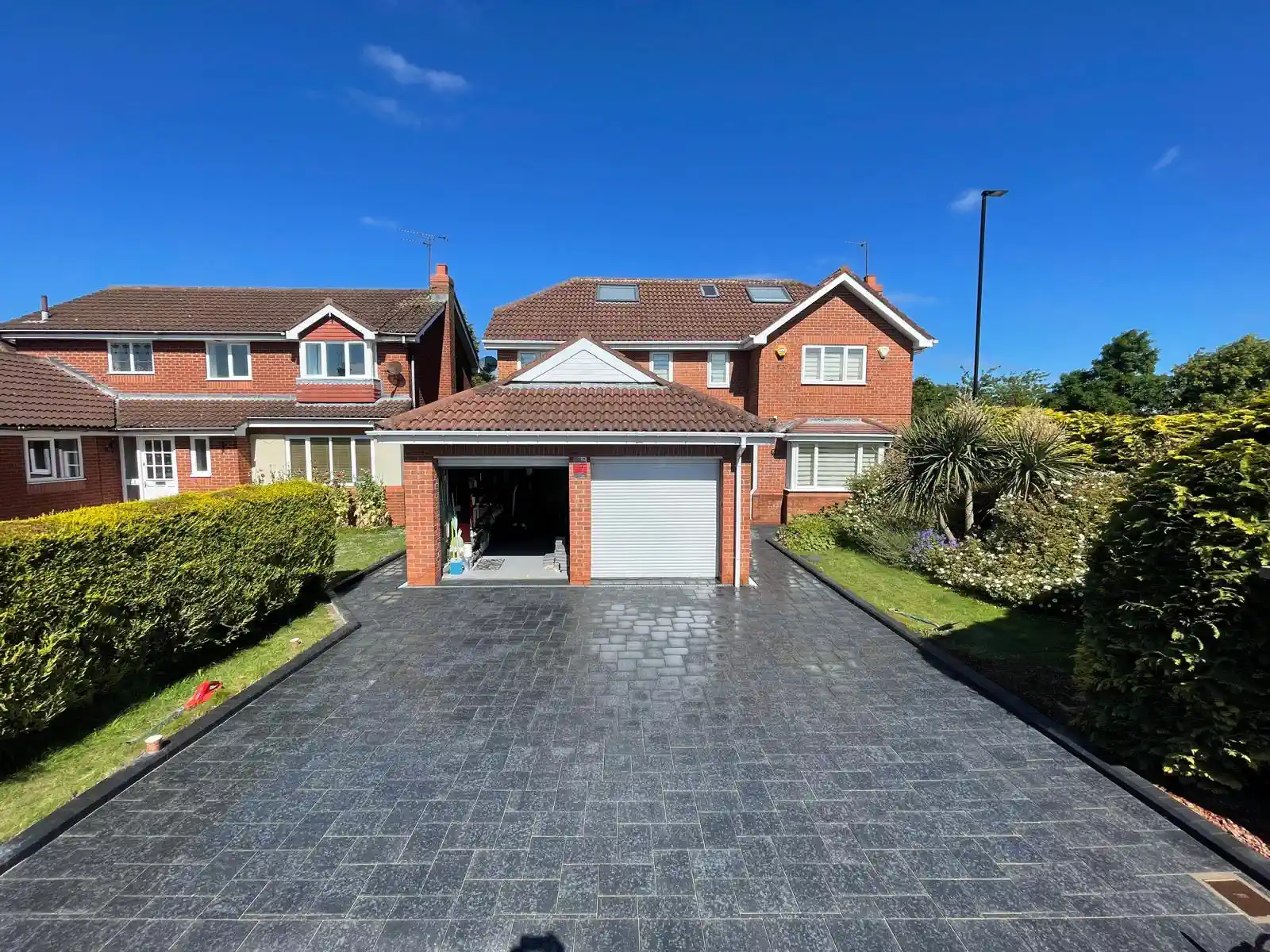


One clarification on the photographs above: the brindle block job with the circular beds is a courtyard, not a driveway. It's here for the cutting and the circle work, not as a vehicle surface.
A fixed price before anyone starts digging
We measure, agree the build-up in writing and give you one price. It doesn't move. Not for hard ground, old concrete, rubble, roots or a soft spot — that's our risk and it's already in the number.
Zero deposit option for jobs that qualify — we confirm the terms with your fixed price.
Everyone else quotes "subject to survey" because they haven't checked the job properly. We do the survey first — measuring properly, checking levels and where the water goes, what planning rules apply, what has to come out, manholes, ducts, and access for digger and skip. So by the time we write the number down, we know what the job needs. That's why the price doesn't move, and why we can put it in writing before we start. If we ever do hit something, we stop, show you, and agree in writing what happens before we carry on. Ask your other quotes what they checked before they priced.
Ten years on the sub-base, ten years on the surface
Most guarantees quietly stop at the surface. Ours starts underneath it: the excavation depth, the membrane, the compacted sub-base, the falls and the edge restraints carry ten years, because that is the part that sinks and the part you can't check. The paving on top carries ten as well, because the laying is our workmanship — wear, staining and fair fading are the only things it doesn't cover, and the full terms say exactly which.
On block paving the surface term is easy to stand behind: individual blocks can be lifted and relaid, so a fault in the laying is put right without disturbing the rest.
Common questions about block paving
Why does block paving sink?
Almost never because of the blocks. It sinks because the sub-base was too shallow, wasn't compacted in layers, or the edges weren't haunched so the whole field crept outwards and the joints opened. Fix the base and the same blocks will sit flat for twenty years.
What is a soldier course and do I need one?
It's a row of blocks laid end-on around the perimeter, usually in a contrasting colour. Structurally it's part of the edge detail; visually it's what makes a drive look finished rather than just covered. It can be cut and curved to follow a bay window or a curved border.
Will weeds grow through it?
Weeds don't grow up through a properly laid drive — they germinate in the top of the joint from windblown seed and dirt. Kiln-dried sand brushed in properly, or a polymeric jointing sand, plus an occasional sweep, keeps it to almost nothing.
Can block paving be repaired?
Better than any other surface. If a service has to be dug up, or a small area settles, we lift the blocks, correct the base and relay the same blocks. There's no patch line. We recommend keeping a small stock of spare blocks from your batch.
Is it permeable?
Standard block paving on a standard base isn't. Permeable block paving — wider joints, angular jointing grit and an open-graded sub-base — is, and it removes the planning question about draining onto the highway entirely. It costs a bit more and is often worth it.
Does it need sealing?
No, it's optional. Sealing can deepen the colour and make cleaning easier, but it has to be reapplied and a badly-applied seal looks worse than no seal at all. We'd rather you spent the money on getting the base right.
Towns we cover
We cover Hastings and a 25-mile radius.
- Hastings
- St Leonards-on-Sea
- Bexhill-on-Sea
- Battle
- Rye
- Eastbourne
- Hailsham
- Robertsbridge